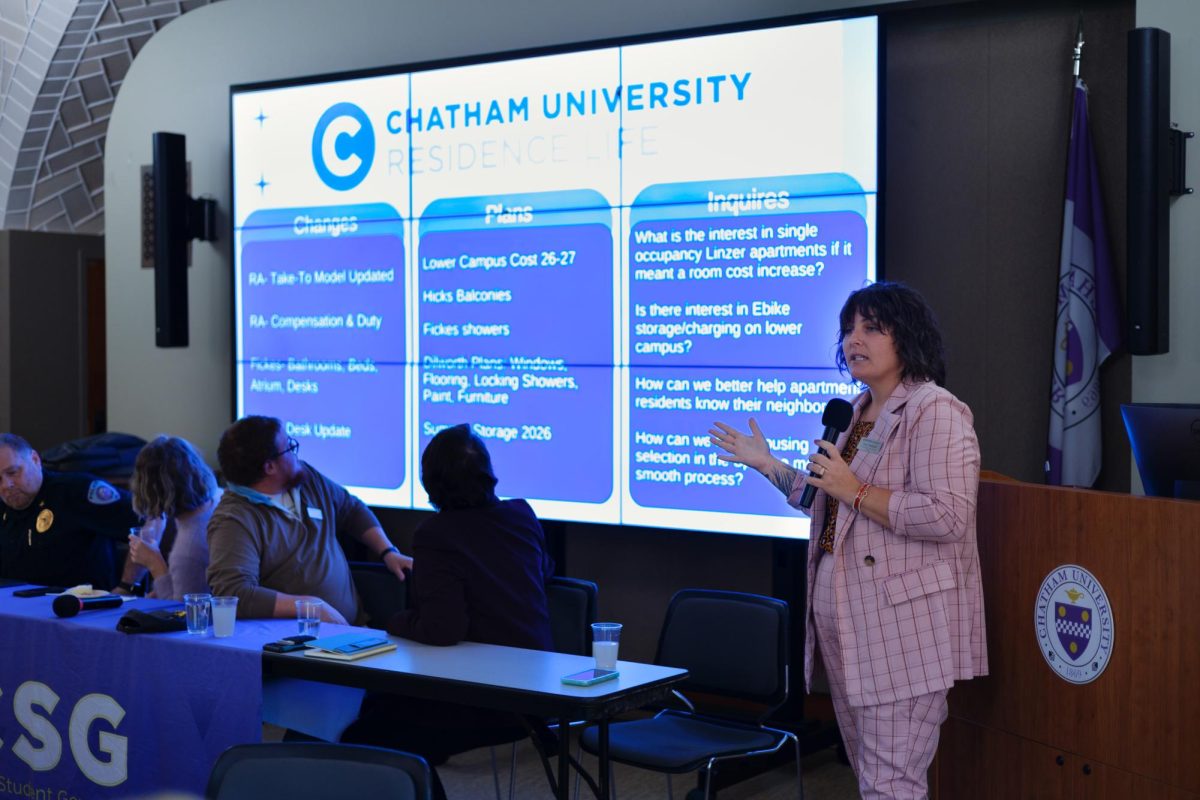
Chatham Student Government (CSG) held its town hall on Nov. 6, when students could pose their questions and concerns to University representatives.
The panel included University President Lisa Lambert, Falk School of Sustainability & Environment Dean Emily Heffernan, Coordinator of Student Engagement and Belonging Ali Hoefnagel, Assistant Dean of Residence Life and Student Conduct Natty Burfield, Director of Facilities Mike Kukawa and Interim Chief of Police Michael Colberg.
Here are some key points from the panel, in case you missed it.
Q: What is Chatham’s biggest problem, and how are is the University working to address it?
Lambert said Chatham has a PR problem – not enough people know where the University is or the core values that it stands for. She is aiming to increase Chatham’s profile by networking with alumni.
“I think my unique perspective of having been a faculty member here, having grown up at Chatham, it gives me a unique opportunity to tell these stories,” Lambert said. “I can’t do it without you. Keep letting me know about both our needs and our successes.”
The University additionally received a Keystone grant to address historical restoration of buildings on campus, she said.
Q: Are there plans to create a universal generative AI policy for staff, faculty and students?
According to Lambert, that would fall under the Office of Academic Affairs. She agreed that the University needs more formal policies that both embrace the positives of AI and address the potential pitfalls of it. Vice President of Academic Affairs Matt Redinger is actively involved in working with the faculty to develop this plan.
“I’ve got a student from the [Art, Design & Communication department] who is designing the president’s annual Christmas card this year, not going to use AI or some other device to create that,” Lambert said. “We’re slowly getting there, but again, if we’ve got concerns, we’re hearing them loud and clear, and we’re going to continue to address that.”
Q: What plan does Chatham have in response to the increasing Immigration and Customs Enforcement (ICE) presence in Pittsburgh?
ICE must have a judicial warrant and must be escorted by campus police and the dean of students to legally be on campus, according to Colberg. Campus police would verify whether the judicial warrant names a specific person before taking ICE where it needs to go.
It is not welcome in uncommon areas, which Burfield defined as any place that is accessible by Chatham ID.
The University does have an extensive policy in place and readily available on my.Chatham. edu, under “registrations and forms and policies,” Colberg said.
Q: Why did Chatham change the credit limit?
Lambert said that while the 21-credit limit was popular, students used over 100 credits each semester, which led to over 35 classes without faculty to cover them. This is ultimately why the University made the decision to change the flat rate of credits covered under financial aid to 18 after the spring 2025 semester.
“It was certainly not done quickly,” Lambert said. “We’ve got a number of years of data on it, and it was something that we felt was not really equitable, that because there’s a cost with each of those overloads, people who are not overloading we’re helping to defray the cost of it.”
She said that if there was expressed interest, the University would consider revisiting the issue in the future.
Q: Will lockable showers be added to all upper-campus residence halls?
Burfield said that the plan is to add lockable shower stalls to Fickes Hall this year and update Dilworth Hall in summer 2026. Though there was no specific timeframe given, Woodland Hall would be next to receive renovations.
Burfield added that if there is a shower in a student’s building with a lockable door that aligns with their gender identity, they should use that bathroom while the others are being brought up to standard.