The end of the semester is looking a little different this term with the return of finals week here at Chatham University. Reading day on Monday, Dec. 8, will kick off the start of a stressful week for most students.
For students and faculty who are still confused about policies and procedures for finals week, the Communiqué spoke to the Provost and Vice President of Academic Affairs Matthew Redinger via email to answer some frequently asked questions to help students and faculty navigate the week ahead.
Answers have been shortened for clarity and conciseness.
Q: Could you give a brief explanation about exactly what finals week is and what the schedule looks like?
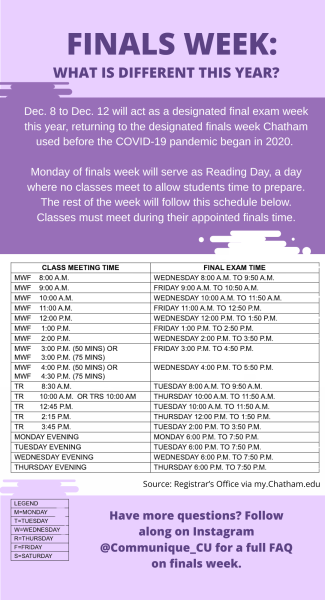
MR: Finals week, set apart on a different schedule from that during which regular class times were held during the semester, is very common in higher education. Every university with which I have taught or worked as an administrator has used them, and they all follow the basic format as the finals schedule published by the Registrar’s Office at the beginning of the semester. Here are the links for the schedules from my.Chatham:
- fall 2025- https://my.chatham.edu/documents/view.cfm?DocID=9483
- spring 2026- https://my.chatham.edu/documents/view.cfm?DocID=9484
Having a separate finals week schedule allows the University to coordinate finals better across the institution to avoid time conflicts that would confuse students and make the whole process more difficult. I was not at Chatham before we had a finals week, so I am not sure how finals were scheduled before, but once finals week has become the norm, it makes things much fairer and more predictable for students.
Q: What is Reading day, and how are students and faculty supposed to use it?
MR: Universities often identify a “reading day” before final exams to provide students with a dedicated opportunity to get ready for their finals and to breathe before the stress of the week. Faculty are not supposed to schedule regular class activities on that day, though some may hold optional review sessions during the regular class time. It’s a time to allow students to focus without the distractions of other classes and assignments.
Q: Why did Chatham bring back finals week?
MR: Finals week was previously a part of the institution for nearly a decade, but was dropped during [COVID-19]. It has returned as part of the University’s approved Academic Calendar, voted upon by faculty and published on the University website. It’s a small part of a more comprehensive approach we are taking to provide more certainty and predictability for students. A good example of this is the new Chatham grading scale that all undergraduate courses will follow. That way, an 82 in one course gets the same grade as an 82 in another discipline. All an effort to increase predictability, student satisfaction and, ultimately, student success.
Q: How does having a finals week benefit Chatham students?
MR: Finals week benefits students because it avoids class scheduling conflicts for students who are taking more than one course. Finals exam periods are longer than regular class periods (one hour and 50 minutes, compared to a 50-minute class period). Thus, they have to be on a different schedule to avoid student scheduling conflicts.
Q: Will every class have to meet during finals week, even if students only have a final paper due?
MR: The final exam week is included in the required instructional time for 15-week courses. Thus, class meetings during final exam week are not optional for 15-week courses, and they are already calculated into the class requirements.
Under the U.S. Department of Education regulations, universities and colleges have to follow guidelines for credit hours so that a student’s experience at Chatham is fundamentally similar to the experience of a student at Pitt, Point Park or UCLA. A standard credit-hour calculation provides more standardized measures of student progress, faculty workloads and student federal financial aid eligibility. Meeting the required instructional hours also ensures the credit earned by students holds integrity in the transferability of credits between Chatham University and other accredited institutions.
Q: How should students plan their work schedules for finals week? Will students who work for the University have their schedules adjusted?
MR: The reality today is that more and more students have jobs outside of school. For students who have jobs off campus, I recommend early and frequent communication with their employers. Most employers will work with a valued student employee to allow time away from work for final exams.
For students with on-campus jobs, their managers understand that student-employees are students first. They are expected to make schedule adjustments to accommodate their student-employees’ finals schedules. Again, whether an employer is off campus or just across the quad, early and frequent communication is the key.
Q: Has there been formal communication about the finals week schedule up until this point?
MR: The finals schedule published by the University Registrar’s Office adheres to the approved course scheduling grid for the University. Students enrolled in night classes, sub-terms and or a class meeting at an alternative day/time will receive guidance from their instructor. The instructor will schedule and administer a final based on their course. The faculty and the deans are aware that the finals week schedule is different from the normal class schedule.
When the finals week was reinstituted, it was at the request of faculty who had difficulty scheduling their class finals. This is becoming a larger issue as Chatham is growing and expanding both its offerings and the partners with which we offer programs.
When Chatham was a small undergraduate college for women, the class schedule could be much more easily customized to accommodate the student body. But as Chatham has grown into a more complex university with undergraduate and graduate programs, a higher degree of coordination became necessary. Hence, the need for a final week schedule.
Until it becomes the new normal, we do have to communicate it more frequently.
Q: How does the University plan to address student and faculty concerns about finals week, such as missing times for certain classes?
MR: As provost, I am always open to feedback on the students’ and faculty members’ experiences. If students encounter difficulties in their finals week schedule, they can forward their perspectives to the Office of Academic Affairs at [email protected]. The Provost’s Office monitors this account daily, and any experiences students or faculty would like to share with the provost will be received there.
Q: Why is the finals week schedule set up the way it is?
MR: The final exam schedule is intended to avoid scheduling conflicts, provide student and instructor predictability, ensure classroom availability and provide a more fair and equitable schedule for students to demonstrate their mastery of the learning outcomes for all of their courses, whenever they were scheduled during the semester. Most importantly, we want students to have a balance, and so the scheduling grid prevents exam overload by ensuring a student doesn’t have a full schedule of finals on the same day.