Chatham University’s School of Business and Enterprise (SBE) and Falk School of Sustainability and the Environment (FSSE) are set to merge by the 2026-27 academic year, President Lisa Lambert announced in an email sent Jan. 29 to the Chatham community.
“I’m very excited about it,” Lambert said in an interview. “It takes two groups that were struggling a little bit on their own, put them together, and they will be stronger together.”
Provost and Vice President for Academic Affairs Matt Redinger came up with the idea about a month ago and consulted with Lambert and the Board of Trustees before a decision was reached. A motivating factor was the difficulty in maintaining operations in the smaller schools.
“We had to make it happen during the semester, because we’ve learned that, you know, while it’s more convenient to make big moves in the summer, it catches people by surprise, and people don’t like being surprised,” he said in an interview. “But, the faculty wouldn’t have had the opportunity to consult. We really need their voice. Students mostly wouldn’t be around to lend their voices, and so we’re spending this semester to do a deep dive with all of the people that are going to be directly impacted by this decision.”
Redinger is hopeful that the merged schools will become similar in name and size to Chatham’s two other colleges. He and the administration are soliciting feedback from faculty and students on the new formal name of the merged schools and on what the future of could look like for both the business and sustainability programs.

“I think one of the clear signs that this is kind of elevating those two schools is, you know, there’s a lot of talk among faculty about faculty senate, better shared governance organization,” Redinger said in an interview. “[In this] committee, the Falk School would have two representatives, and business would have one. [The] College of Arts and Sciences has three. [The] College of Health Sciences has three. Now the Falk College is going to have three, as well. So those faculty are going to have a much, much greater voice in their work than they would as two separate schools.”
Vicky Streeton ‘27, a sustainability major, was initially surprised by the announcement.
“I had no idea this was even on the table as an option, so I did feel rather blindsided,” Streeton said in an email interview. The email “gave some insight as to why this merger was taking place, but Dean [Emily] Heffernan sent out an email detailing the results of this merger. I felt better after reading her email — she provided some reassurances for students regarding stability and security in academic programs.”
Founded in 2010, the FSSE was inspired by the work of 1929 grad environmentalist Rachel Carson and is one of the first schools in the U.S. solely dedicated to sustainability and the environment. It is based on Chatham’s Eden Hall campus, which has seen cuts in programming since the University’s fall 2023 reorganization effort.
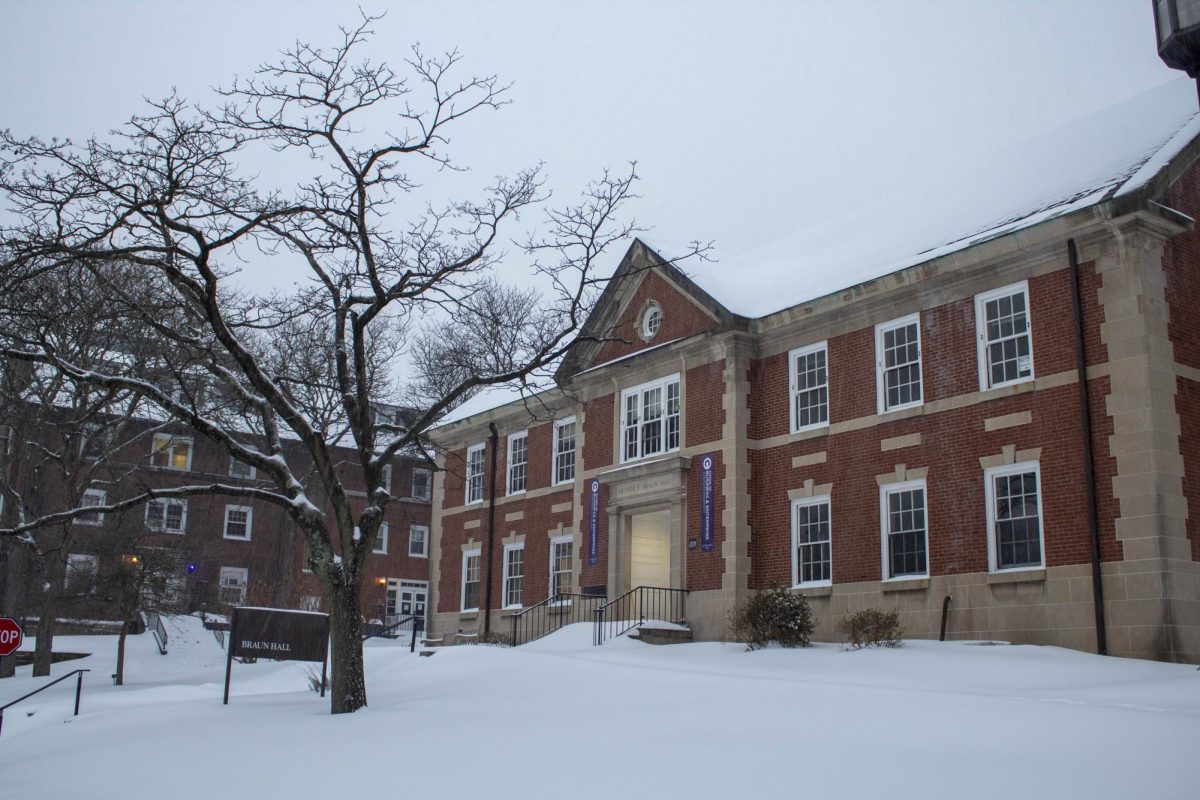
The SBE was originally part of the College of Arts & Sciences and was founded as a separate school by former President Rhonda Phillips in fall 2024. Braun Hall was renovated to become the school’s primary location.
“Those spaces [in Braun Hall] will still be available and primarily dedicated to business student success,” Redinger said. “I mean, the name on the outside will change from School of Business to something else, but those renovations are all contributing to the success of the new college.”
Heffernan will serve as dean of the newly merged school beginning in the fall. Current dean of the SBE Debbie DeLong will be on leave for the rest of the spring semester and return as a professor of business in the fall.
“Dr. Heffernan has more years of experience at the dean level. She has a broader range of programs that she has overseen,” Lambert said. “While we really appreciate the work that Dr. DeLong did, that Dr. Heffernan is better positioned to embrace both units.”
Assistant Professor of Management Jungook Kim was informed of the merger a few hours before the University made the public announcement about it.
“I generally agree with the leadership about the rationale of this merger,” Kim said. “I think it makes sense, business sense, but why would you eliminate [DeLong] immediately? I just don’t understand the reason behind that. We have no information. I believe that none of us here in the business school knows about that.”
Brooklyn Tomczak ‘27, an SBE student, participated in a leadership program led by DeLong and is unsure of the status of this program now that DeLong is on a leave of absence.
“I think the only thing that might really impact me is Dr. DeLong no longer being here and bringing Dr. Heffernan into her position,” Tomczak said. “I don’t know if [Heffernan] is going to be able to get me the same business resources and connections that I got through Dr. DeLong.”
Redinger agreed with Lambert’s sentiment that Heffernan’s experience makes her well-suited for the position.
“It’ll be a great thing for the schools,” Redinger said. “We’re doing everything we can to make sure that there are no bumps in the road to the students by this decision… We’ll be working hard with them to make sure that this does turn out to be really a great thing, that I’m absolutely convinced that it will be.”
Many Chatham community members expressed concern regarding the location of classes, such as FSSE classes being held at Shadyside or SBE classes being moved to Eden Hall.
“Eden Hall was the reason I came to Chatham in the first place, so my only hope with this merger is that the Eden Hall experience is emphasized more than ever and not overlooked by the business school being located on Shadyside’s campus,” Streeton said. “My favorite classes I’ve taken during my time at Chatham have all been at Eden Hall, and I wish for students to genuinely enjoy their time out there.”
Redinger said that for FSSE students, the classes that need to be held at Eden Hall will remain there while others will be held at Shadyside. For business students, most classes will stay on Shadyside’s campus.
“We’re really trying to concentrate the classes here, except the ones that need to be out there to actually use the resources,” Lambert said. “No point in putting somebody on a shuttle for 40 minutes just to go and sit in the classroom. So again, that will be up to the faculty to determine what needs to be there and what needs to be [at Shadyside].”
Some students and faculty are optimistic about the merger’s potential, hoping it will strengthen programs at both campuses.
“I do think this is a great opportunity to give students the flexibility to try new courses and explore different subject areas within the combined Falk and Business schools,” Streeton said.
Kim encouraged students not to worry about the decision.
There will be more opportunities for the students in terms of new majors or new classes,” Kim said, “and more resources too.”