Chatham University is a consistently growing and changing institution. As it evolves, staff and faculty come and go as the needs and goals of the institution change. What students don’t see is the work and processes that go into University reorganization, more specifically, hiring new faculty and staff.
Provost, Vice President for Academic Affairs and Accreditation Liaison Officer Matt Redinger is currently wrapping up the search for the new dean for the College of Health Sciences and discussed the step-by-step process of hiring faculty and staff.
When a role becomes open, Redinger explained that the position is first assessed in order to ensure that the University is hiring someone whom it truly needs. The Position Control Management (PCM) committee, which is made up of President Lisa Lambert, Redinger, Chief Financial and Administrative Officer Leonard Cullo Jr. and human resource representatives, do a thorough review of the position description and confirm that the University can afford it.
“No search is automatic, frankly, because we have to make sure that the search we conduct is for the right responsibilities,” Redinger said.
Once the PCM committee confirms the position, the role is advertised online. Though positions are promoted outside of the University as part of an open search, they are also brought to light internally.
“I’m a big fan of open searches because it’s good for everybody to have an open search. It’s better for the candidate. It’s better for the University,” Redinger said. “But there are all kinds of attendant expenses, and we are in a place where we need to make sure that we are economizing where we can, where it’s appropriate.”
While these advertisements are live, the University works to build a search committee composed of those who would be most immediately impacted by the position, Redinger explained. It is the job of the search committee to promote fairness, diversity and a sense of shared governance during the hiring process, specifically striving to avoid implicit bias during hiring. While the University used to have faculty and staff members called search advocates who were trained in inclusive hiring practices to support the search committees, this program no longer exists at Chatham.
“We just can’t afford stipends for that kind of thing anymore. And we have more searches than we have trained people,” Redinger stated. “We’re trying to make ideals of the search advocate program without incurring the costs.”
The University then allows for the job posting to sit and receive applicants.
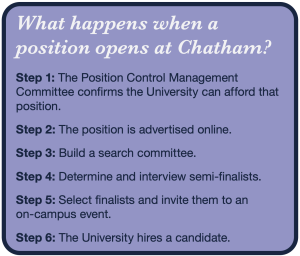
Once this application period has passed, the search committee reviews applicants to determine a list of semifinalists. After a round of interviews, the finalists are selected. A few select finalists are then invited to campus as part of a public event. Candidates for a faculty position may teach a class while an administrator may prepare a presentation. This event allows the search committee to solicit feedback from as many people as possible on campus.
“It can be a long process because we’re inviting someone into the community,” Redinger said. “This is [not an] insignificant investment in finances and time and everything to make sure that we’re getting the right person here on campus.”
After the finalists’ visit, the search committee recommends a specific candidate. It is then decided who will be hired.
Redinger became the provost on June 1, 2025, and explained how being provost plays a role in his work with hiring.
“My goal as the provost is to make sure that we offer the best programs we can with the best faculty that we can afford and make sure those programs are doing what it is we say that they do,” he said.
Under former President Rhonda Phillips, search committees weren’t always used to fill high-profile positions, including hiring Dr. Patsy Kraeger to fill the new role of chief of staff. This prompted concerns from some faculty and staff about ethical hiring practices. After Phillips left the institution in spring 2025 and Lambert was promoted to president, the chief of staff position was eliminated. Lambert stated in an email that she didn’t feel as though the University needed a chief of staff given her familiarity with the University and Pittsburgh.
The way the chief of staff position was created and filled opened up a larger conversation about the importance of hiring processes and more specifically, open searches under the previous presidency.
Associate Professor Jennie Sweet-Cushman said in an interview that the new president and provost have given her fresh hope.
“I feel much more positive this year than I have in a number of years,” she said, noting the openness of the new president and provost to welcome feedback.
University leadership is optimistic, as well.
“I’m thrilled for Chatham and its future. I truly am,” Redinger said.