While Brook Gaetani ‘26 was applying to graduate schools, the Department of Education was reclassifying advanced degrees as no longer professional.
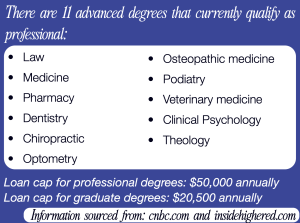
The Department of Education recently amended federal student loan policy by changing the designation of certain degrees as “graduate” vs. “professional.” Students in advanced degree programs that are considered graduate are eligible for $20,500 a year while students in programs considered professional are eligible for $50,000 a year.
Programs such as nursing and social work have been reclassified as graduate, while advanced degrees in fields such as dentistry and law retain their professional status.
Vice President of Operations and Communications Bill Campbell said the University has not observed changes in enrollment as a result of this federal action to date.
“Chatham is working with our professional organizations to advocate for broadening the definition to include more graduate programs,” Campbell said in an email interview. “We will continue to monitor the legislation, and the Office of Financial Aid will counsel students accordingly on their options.”
As students prepare for the upcoming academic year, many are feeling the impacts of this change.
“The exclusion of social work from being classified as a ‘professional degree’ is deeply concerning and disheartening,” Gaetani said. “The value of social work is minimized, and we are questioned for choosing a career that demands extensive education, emotional resilience and unwavering dedication while offering limited financial compensation.”
Dr. Erica Maloney is an assistant professor of social work at Chatham University and a practicing social worker. Social workers practice in education, the justice system and mental health, among other fields. According to Maloney, there is currently a shortage of a quarter of a million social workers in mental health alone.
“It’s terrifying,” Maloney said about the shortage. “We’re already so understaffed. We already have so few people in the pipeline.”
In Pennsylvania, a master’s degree in social work is required to become a licensed social worker in the state, and this level of licensure is needed to work in most behavioral health settings.
Gaetani will pursue her master’s in social work in Pittsburgh following graduation.
“The financial burden associated with pursuing a graduate degree in social work is significant, particularly for a profession that is already undervalued and undercompensated,” Gaetani said.
In-state tuition for the school of social work at the University of Pittsburgh is $26,876 a year, which surpasses the federal loan cap.
“A lot of people can’t even get [private loans] because there’s credit requirements, too,” Maloney said. It “becomes an equity issue.”
Dr. Elizabeth Skrovanek, assistant professor of nursing at Chatham, echoed Maloney’s concerns of equitable access to education.
“Financial feasibility is a major determinant of educational decisions, particularly for working adults, first-generation college students and individuals from historically marginalized communities,” Skrovanek said. “[These are] groups that make up a substantial portion of the nursing student population and are essential to workforce diversity.”
The nursing field has faced similar shortages and was also one of the advanced degree programs reclassified as graduate.
“Emergency departments are struggling and understaffed,” Skrovanek said. “This proposed policy that might limit access to advanced nursing education could worsen the current shortage, particularly in specialized and leadership roles.”
The tuition cost for a full-term year of nursing graduate school at the University of Pittsburgh costs $31,510, which is more than $10,000 over the annual loan cap. In Pennsylvania, a master’s or doctoral degree is needed to become a nurse practitioner (NP).
“Before the decrease in student loan caps, it was always a goal of mine to attend grad school,” said nursing major Samantha Orr ‘29. “While I would have to work for a while as a nurse anyway to gain experience, to attend graduate school, I would have to work twice as long to afford it.”
For both Maloney and Skrovanek, the resounding concern is that this change will push more people out of the social work and nursing pipelines, intensifying the shortage of professionals.
“When people have to wait for mental health services, people die,” Maloney said. “The longer people wait for services, the longer it takes for them to get better. And that’s the same for mental health as it is with physical health.”
Despite the new challenges presented, Gaetani is determined to pursue her passion through education and dedication to her work.
“Social workers have always been advocates in the face of diversity,” Gaetani said. “Regardless of systemic barriers or recognition, we will continue to find ways to support, empower and fight for those who need us most.”
Campbell said that a market analysis is still underway of College of Health Sciences programs.