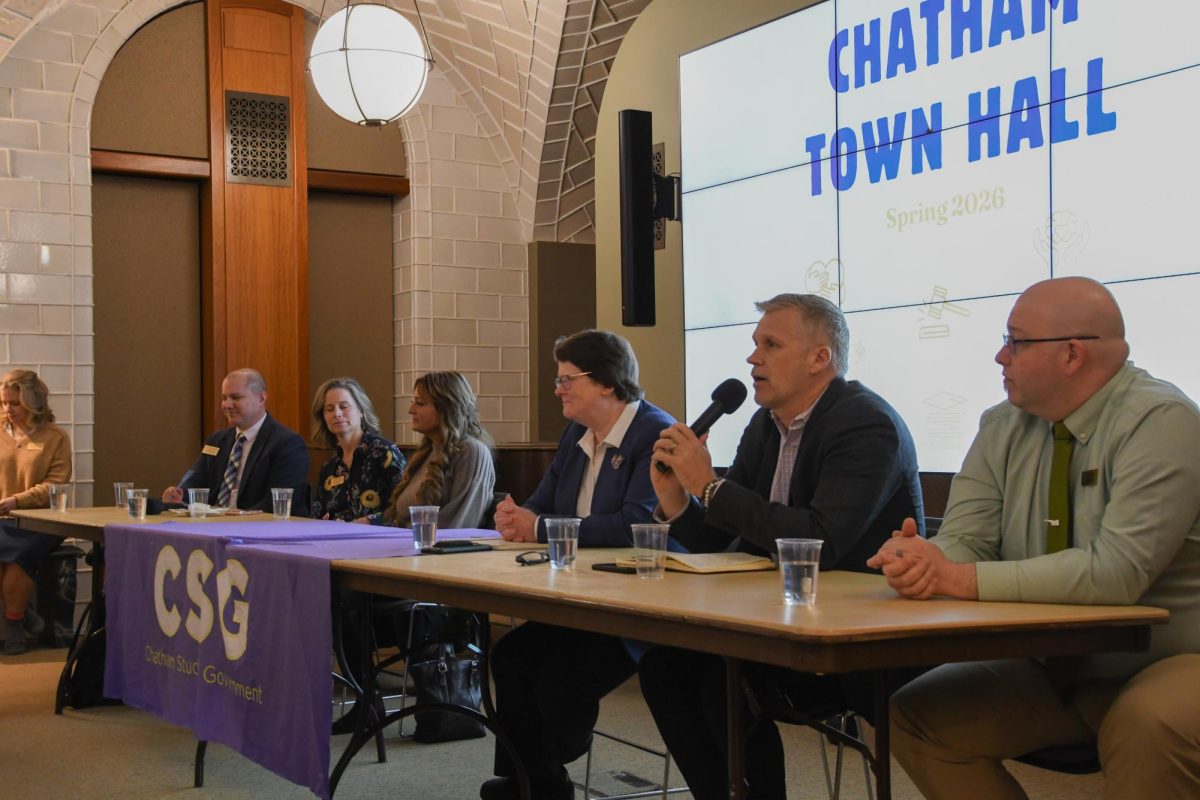
Chatham University students had the opportunity to listen to updates from University representatives, and, in turn, asked them pressing questions and concerns at Chatham Student Government (CSG)’s spring town hall.
The panel included University administrators President Lisa Lambert, Vice President of Operations and Communications Bill Campbell, Associate Dean & Director of Academic Success Jeff Bukowski, Falk School of Sustainability & Environment Dean Emily Heffernan, Associate Vice President of Financial Aid Jill Bittel and Parkhurst General Manager Mike Logesky.
Here are a few key takeaways from the panel, in case you missed it.
Q) Two separate questions were asked about the use of generative AI in marketing and academics and the ethical use of AI as a school with sustainability in its mission statement.
Bukowski, who serves as academic integrity officer, said he has been dealing with AI issues for some time. The Committee on Academic Policy (CAP), which is made up of faculty, is currently working on formalizing a policy.
“One of the things that we’re really hoping to do is to allow faculty to have the freedom to use that technology in ways that might be appropriate in the classroom, for you to be able to learn and engage with that because obviously it’s something that is continually present in our society,” Bukowski said. “Of course, there are times when people are using AI inappropriately, and that’s where the academic integrity component comes in.”
From an IT and marketing perspective, Campbell said that certain technologies like Workday have AI capabilities built into them and that the IT department is developing a five-year strategic plan to work alongside the implementation of Workday next academic year. Additionally, the University is looking into embedding tools in web-based sites to help maximize generative search on the web, and it is looking into the ability to pilot, test and implement some AI-based chatbots for self-service functions.
“The technology has advanced a lot where those are much more helpful and accurate than they were about a year or two ago when we tried a pilot of this,” Campbell said. “We anticipate that we’ll be seeing some of those things coming into our systems and tools that students and employees will see.”
Later in the meeting, Heffernan responded to a question about whether or not Chatham’s use of AI goes against its pillar of sustainability. She encouraged members of the Chatham community to be thoughtful about the ways that AI is being used and to make sure to ask “are you thinking with AI, or are you letting AI think for you?”
She recommends that community members are cognizant of what the energy use draw is for AI, and that these are the types of questions that faculty are preparing Chatham students to be able to tackle.
“I don’t think that AI and principles of sustainability are at odds with each other. I have colleagues who are using AI to evaluate sustainability models, but it’s how much data, how much energy is used in the process. There’s a lot that AI cannot answer, that we as humans need to do the research evaluation to see,” Heffernan said. “They are not mutually exclusive, but I also don’t just blindly, you know, go into these new worlds. We need to be ethical, moral and keep our eyes open as we evaluate the nuts and bolts of the data.”
Q) Sustainability is what drew a lot of students to Chatham, and what sets it apart from a lot of colleges. Over the past few years, it seems to be getting lost a little bit. Do you see Chatham returning to this mission? Are there steps to revive this project?
Heffernan said that she is excited about bringing the School of Business and Enterprise and the Falk School of Sustainability and the Environment together. She is currently working to expand operations at Eden Hall and is thinking about using the resources that Chatham has to be as efficient as possible.
“Our apiary is growing. The food that we grow and produce and comes back to the dining hall is growing. We are growing,” Heffernan said. “We’re converting some lawn into meadow for wildflower pollinator habitat, the growth of trails so we can explore the natural environment more and really making use of the wonderful resources we have, which are both space and building and play space, but also the human resources, so making sure that there are opportunities for people to shine as individuals and bring their own strengths.”
Campbell added the director of facilities and building systems at Eden Hall has taken on overseeing housekeeping grounds and is digging into the University’s utilities, which play a core part in its use of energy. Before the University’s reorganization, it used to be a part of the ENERGY STARS program, a national ranking system for energy consumption. The director of facilities and building systems is looking into returning Chatham into the system.
Q) Is there a way to get more financial aid or scholarships through Chatham for graduate school?
Bittel said that, universally, graduate students cannot get scholarships. Instead, they can look for assistantships or look online for outside scholarships. The Office of Financial Aid also welcomes students to come in and meet with it to help navigate the cost of graduate school.
Heffernan added that the graduate programs that she is affiliated with that the merged School of Business and Enterprise and the Falk School of Sustainability and the Environment have repriced its offerings starting next year, so that an entire graduate degree can be afforded using federal loans.
Q) Why is it difficult for some students to do the integrated degree program (IDP) and transfer credits? How can we prevent these challenges from happening?
Lambert said that this is an individualized question, because there is a credit limit in terms of federal financial support, but Chatham’s advising staff can review this with students individually.
Bukowski said that the IDP program poses challenges for students on how to balance an undergraduate student experience while still being focused on the future.
The University is in the process of revamping the IDP program, and more information will be available within the next year.
Q) Can we incorporate old traditions from when Chatham was an all-women’s school?
Lambert said that she is always interested in bringing back traditions when appropriate. She would not recommend that certain traditions like Toe-Dabbling Day, a day where students would throw faculty and staff into the pond, come back out of concern for safety, but she is always interested in hearing what traditions that students are working with Dean of Students Chris Purcell and the Office of Student Affairs to bring back.