

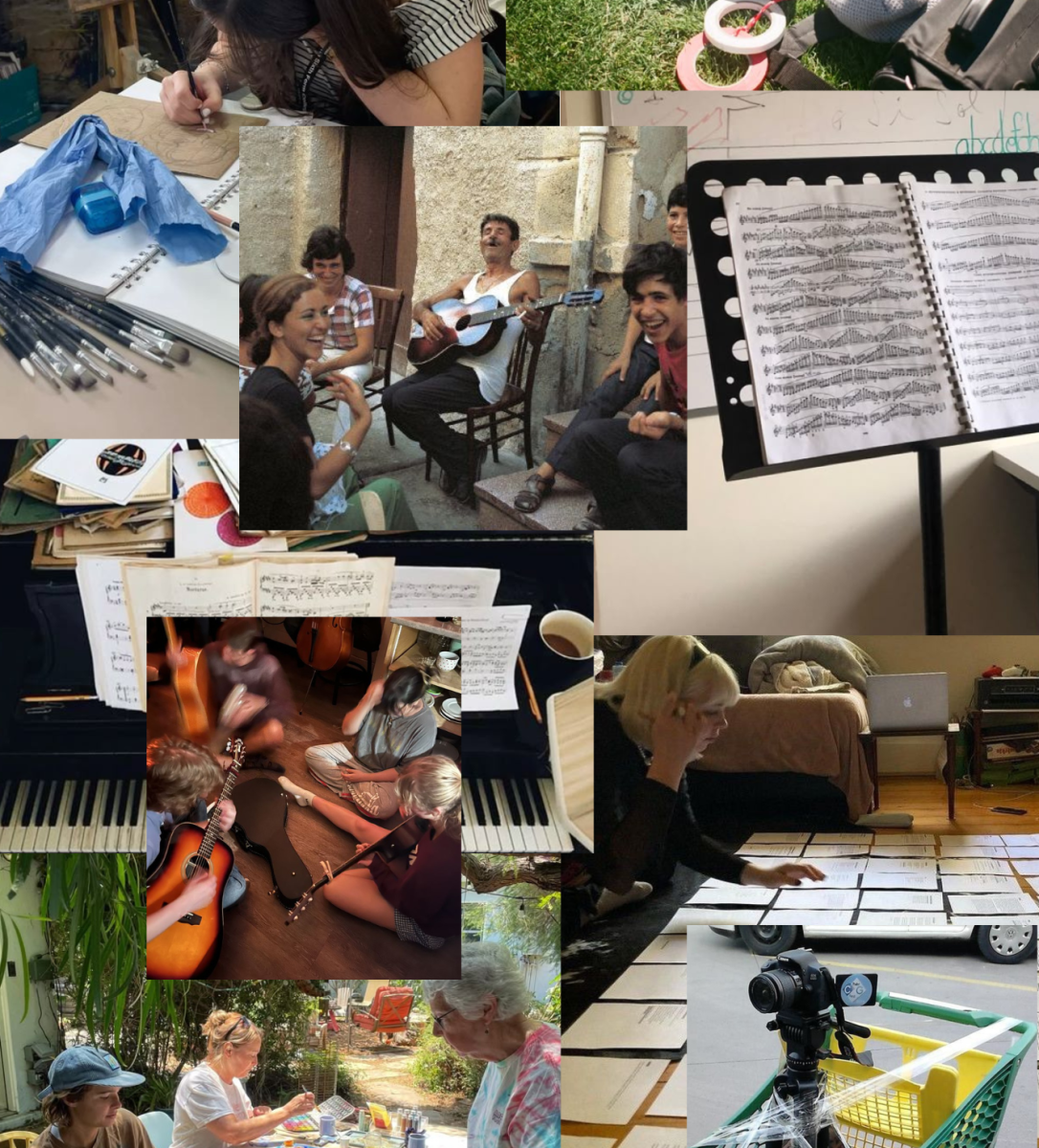
Not to be controversial or anything, but I consider myself a strong proponent of the socialist belief that creativity is innate to human nature, as stated by the likes of Karl Marx and William Morris.
When we’re free from the constraints of material scarcity, and no longer have to worry about choosing between buying groceries or keeping the heat on for the month, creativity wraps its arms around us and lifts us up to the sky, reaching for our wildest desires. It understands us and our insatiable curiosity, pleading with us to go and to explore, to try and to fail and then get up and try again.
Like many other artists and creatives, one part of the creative process I’ve struggled with for a long time is the actual creating part. I grew up in a very practical home, where the mindset was, “If it doesn’t come to you naturally, then it must not be your calling. Do something else.” And this always frustrated me – but I love music! All I think about is music and wanting to make it, so why is this so hard?
In the modern age of AI and fast-paced trend cycles, the disheartening struggle of creation has only become more daunting, looming over me like a beast I’d never learn to topple.
It’s only recently that I feel like I’ve fully reckoned with and understood what the creative process is supposed to look like. Regardless of passion, the creation of something is not meant to be a frictionless act. It’s meant to be a slow, sometimes agonizing process of staring at a blank wall until the right thought strikes, of making mistakes and reworking the same part of your project over and over again, of mulling over a concept repeatedly until, suddenly, you have a whole new perception of it.
In the age of instant gratification and immediate results, the art of waiting has been completely lost on us. We’ve lost the plot on what creativity is even supposed to look like, forgetting that it is bred from boredom. We’ve become accustomed to just looking at the end result with impatience, never looking back or reflecting on how we actually got there (think of The Beatles’ “Let It Be,” David Bowie’s “The Next Day” or Dr. Dre’s “Compton” – all albums that were created non-linearly with the latter two taking at least a decade to make). As a result, we’ve lost touch with the stories we were meant to consume.
This disconnect with our art is what has led us to fall for the standardized formulas that we are constantly being force fed by the powerful labels around us. For them to make their profits, they need us to lose our agency and be satisfied with the stale crumbs on our plate. They exploit the struggling artists they employ with predatory contracts and unfair treatment.
A 2017 Business Insider story revealed that musicians and artists only see 12% of industry profit, despite being part of the majority, and use their talents to churn out another radio hit or TikTok sound. Raye, an award-winning artist who has been in the game for more than 10 years, told Rolling Stone, “there are some incredibly, stupidly, ridiculously talented people who can’t pay their rent who are writing the songs.” The industry takes advantage of talents and passions, watering down art and forcing creatives to play by the rules of a game it made up.
Without the compliance of the artists at the bottom rung, these corporations would not have the power they so mercilessly wield. Look at the biggest music industry conglomerates teaming up with generative AI music companies, allowing the AI to be trained on the works of the artists signed to these labels.
According to a 2025 Al-Jazeera article, “Warner, Universal and Sony had last year sued Suno and Udio … two popular AI song generation tools, accusing them of exploiting the recorded works of artists without compensating them.”
At the realization of the profits they could be missing out on, the big powers in music chose to partner up with the very tools they accused of artist exploitation, choosing to work with them instead and train their “large music model” on licensed music.
The livelihood of these artists could not matter less to these corporations — as soon as this machine is able to churn out a viable, catchy three-minute hit to make them millions, companies will begin to lessen priority on human artists’ financial and artistic needs.
Bang Si-Hyuk, chairman of HYBE (another growing giant within the music industry that often restricts its own artists’ creative freedom) told Billboard, “I have long doubted that the entities that create and produce music will remain human.”
It’s terrifying to give all of yourself to your art. It’s the scariest thing in the world to slide off your protective shell and strip yourself down to the bones, to put precious time and effort into a project only to feel disappointed and unsatisfied with the result.
However, art would not be art without the human touch behind it, including every complexity of the stories, experiences and emotions that have allowed it to come to life. Just as we do, our art is ever-changing. It grows and evolves with us and the world around us.
Before we had anything, we had our creative process. We drew and painted to show others our inner thoughts. We came up with plays and acted out our stories of the past. We banged on drums and sang to connect with our friends and our neighbors. And when we figured out how to write, we wrote and wrote and wrote; to pass on our recipes, to remember what we learned that day, and to communicate our thoughts and deepest fears, insecurities and desires.
This creative flow, one that is complex and all-embracing, cannot be replicated by AI. As much as it can be trained with and fed the information of the work of real musicians, it can never replicate what is human at its core. More than anything, our creativity and our art is the original mark of our humanity. Across different cultures and conceptual maps, traditions and languages, we understand each other and see each other in our most transparent, vulnerable forms. No matter our different lives and experiences, when we present our art to the world, we let go of our shame and lay ourselves bare, urging others to come and take a look. The music that AI pumps out will always pale in comparison to the magnificence of human musical artistry, nothing but a pseudo-art.
Please allow yourself the grace of creativity, of making good and bad art, of making art to show the world and of making art meant just for your eyes, before we forget all that makes us human.