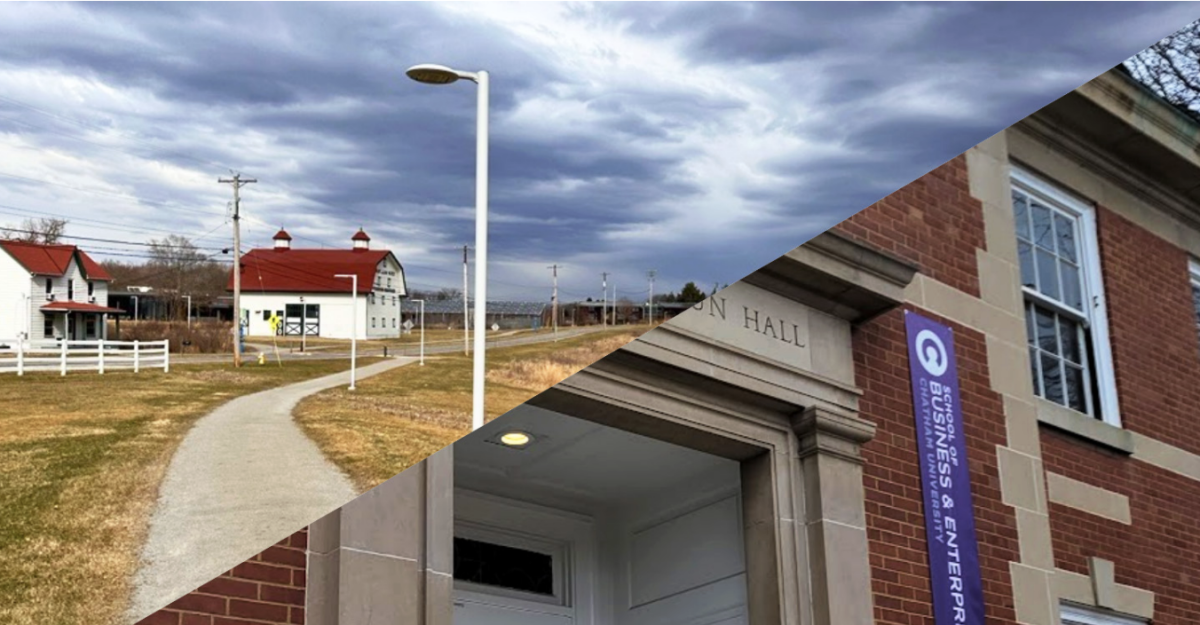
I’ve been no stranger to seemingly random emails announcing some new change to the Falk School of Sustainability & Environment (FSSE). Since my first semester at Chatham University in August 2023, the FSSE has seen: two deans, the closure of Eden Hall’s only residence hall, the loss of the farm’s chickens and goats, changing class locations and desultory shuttle schedules.
However, when I received the news about the merge between the FSSE and the School of Business and Enterprise (SBE), I was eating lunch at the desk of my internship at an herbarium. My first thoughts were of denial. “No, they can’t be serious.” The next were questions. “Why would they do this? Does this even make any sense?” The last were definitive. I needed to write this story.
I’ve attended the FSSE since my first year. I was unsure of how “sciencey” a person I was, but I believed I was in the right place as an environmental science student. I cared about animals, the planet and, of course, sustainability, one of Chatham’s core values. During my first visit to Eden Hall, I felt at home, like a summer camp of people who cared about the Earth just as much as I did. Together, we made the daily 90-minute roundtrip pilgrimage from Shadyside to Eden Hall, our safe haven for farm-fresh meals, classes and community.
The SBE was announced in May 2024, with its pilot year being the 2024-25 school year. Besides some inconvenience with the renovations made to Braun Hall in August 2024, the University’s way of accommodating the SBE was of no concern to me. The business programs minorly intersected with some FSSE classes, such as those with concentrations or minors in sustainable business or development, but otherwise, many FSSE students were surrounded by just each other. All this to say, this announcement has raised more questions than answers to many within the affected programs.
In an email received on Feb. 4, FSSE Dean Emily Heffernan recognized the merge as “a strategic investment in growth, not a response to financial weakness in either school,” and further mentioned benefits including expansions in resources, funding, career pathways and enterprising. In an interview with the Communiqué, President Lisa Lambert said the merge “takes two groups that were struggling a little bit on their own, put them together, and they will be stronger together.”
While two things can be true at once, with such little apparent overlap in the schools’ programs, it still feels as though the administration made a rash decision to throw things at the wall to see what stuck. And what happened to stick was the FSSE and SBE – to each other It feels like an episode of “Power Rangers” watching Megazord – an amalgam of multiple Power Rangers – come to life.
Provost and Vice President for Academic Affairs Matt Redinger’s recent interview with the Communiqué recognizes opportunity to work with student voices on the actions being taken. As a student, I would like to know more. How does this benefit other programs? What does this merge look like for non-sustainability and non-business majors within these schools?
I’m not concerned about the integrity of my education or the veneration FSSE students feel toward their sister programs. I believe I’ve enjoyed the benefits of a quality education through my program, primarily due to the dedicated professors and designated campus. However, as I’ve earned my degree these past three years, the education I’ve received has been far different than the educational experience I signed up for. I can’t help but wonder what the legacy of the Falk School will be for future generations of students to come.
For now, I’ll remain hopeful that students will look out for each other, hold the administration accountable and the greater Chatham network will make decisions that will lead us to becoming a stronger community. I hope if anything, my love for this school, that campus and these people is spotlit. I truly believe there can be benefits in unification, even if I don’t currently see what they are.