

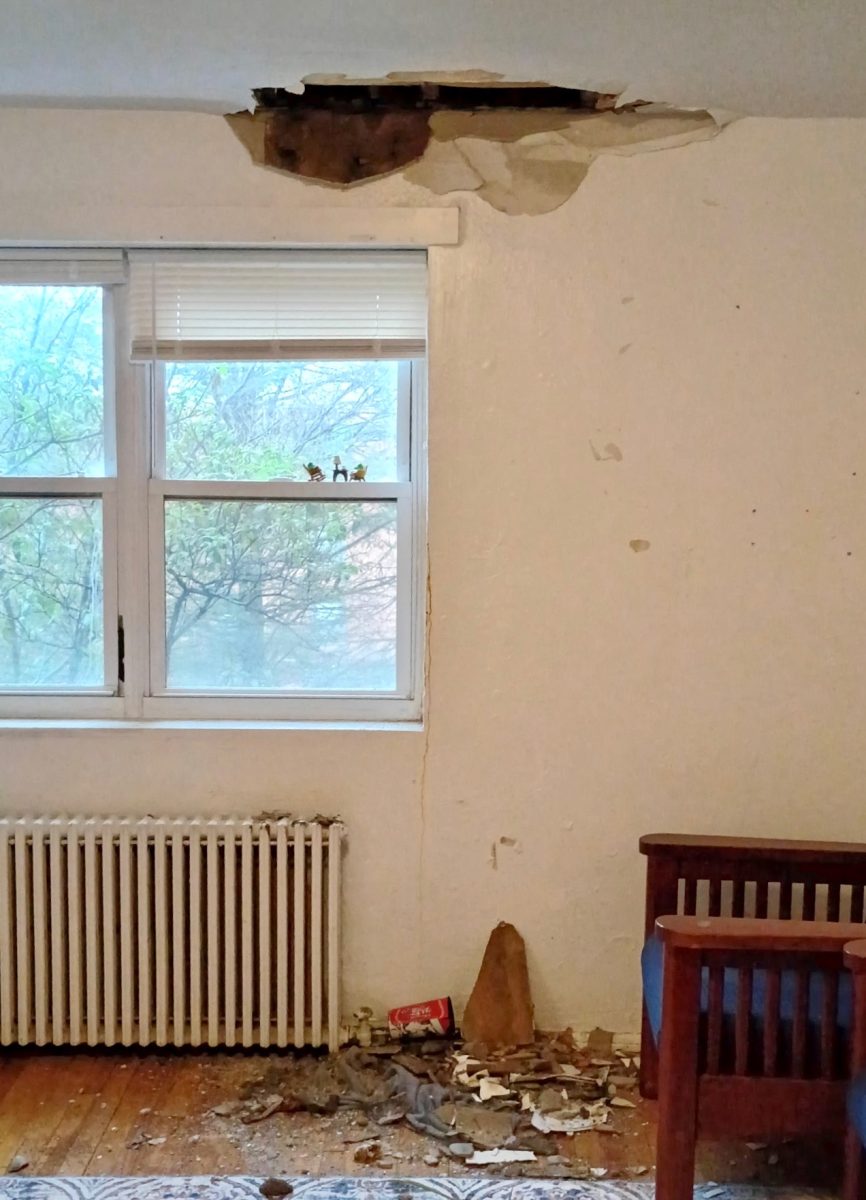
Anna Mack ‘27 and Caleb Trainum ‘27 lived together in Linzer Apartments on lower campus this academic year, up until two weeks ago. After multiple maintenance requests, contact with on-call pro staff and a maintenance visit, a portion of their ceiling fell in. Though both students were uninjured, they had to move to Pelletreau Apartments mid-semester.
Mack and Trainum aren’t the only students facing facilities issues with campus residential buildings.
As housing selection wraps up – and the University maps out its campus maintenance plans for the summer – incidents like this one have prompted conversations among several students about the quality of living conditions on campus. A handful of students living on campus reported to the Communiqué complaints of bug infestations, mold, broken appliances, leaks, broken windows or windows with missing screens.
Mack explained that around spring break, she put in a maintenance request because her window was leaking. The request was marked as “resolved,” without communication to Mack, and a week later she submitted another request because the window was leaking an orange liquid. It wasn’t until Mack called the on-call pro staff that she saw someone arrive; they told her that her ceiling should remain structurally intact until the end of the semester.
“Lo and behold, the next day, my ceiling is on the floor, and that is not where that is supposed to be,” Mack said.
Mack said that, overnight, more rubble and a dead mouse fell from the ceiling.
“The same [maintenance] guy came the day after and was like, ‘I was praying, but I guess it didn’t work.’ I think the infrastructure of this building is going to need a little bit more than a prayer, let’s just say that,” Mack said.
“It was a roof issue,” Director of Facilities Mike Kukawa said. “Part of it was weather. We couldn’t get to the roof for a while because of either snow, cold or rain, so by the time we were able to get up there to repair it, the ceiling did give way. And I know my carpenters who typically do the ceiling work had told me, ‘Mike, That’s giving way. That’s in danger of giving way.’ … In my opinion, we didn’t have the availability to do the roof repair in a timely manner.”
Kukawa said of Mack, “I feel bad for her because she was really good to us. I mean, she was … very understanding. And I feel like we let her down.”
Reports like Mack’s are symptoms of larger problems: the age of the residence halls and lower campus apartments that require intensive and expensive maintenance and upkeep, which pose challenges for the University’s strained financial situation.
“Historic buildings [mean] old. Most of the guts of a building are outdated. Hard to get parts and hard to maintain,” said Assistant Director of Campus Services Scott Tatar.
Kukawa confirmed that many of the University’s buildings were not designed for the demands of modern living simply because of their age.
“We have a lot of electrical upgrades to do. We have a lot of plumbing upgrades to do, and then you have the roofs and windows and doors and security and access,” Kukawa said. “The challenges of resources, especially capital replacements, things like boilers, are expensive. Roofs are expensive, windows are expensive. For those places that actually do have air conditioning, chillers are expensive.”
Assistant Dean of Residence Life & Student Conduct Natty Burfield and Tatar assured students that safety is their priority. Neither Residence Life nor Facilities would place or keep students in housing that they deem to be unsafe, citing the recent closing of Chung Apartments for next academic year as an example.
“There are certain spaces that I’m like ‘this does not meet our standards, and we need to close it’ and part of partnering with Facilities is making sure that we can guarantee that a student’s space is livable, is meeting those standards,” Burfield said. “Move-in day, I can say every student I handed a key to had a satisfactory space that absolutely met all of their needs and was worth every dime that they were paying to get into those spaces.”
Though it is not uncommon for a university’s needs to exceed their means, Chatham has been working to make up a $8 million to $12 million deficit over the last three years, thus forcing the president’s leadership team and other financial actors to be creative with their allocation of funds.
Chief Financial and Administrative Officer Len Cullo said that while the University is currently spending $1 million to $1.5 million on capital expenditures per fiscal year, “I would like to be spending $2 million or more.”
Kukawa and the Facilities team then triage, making decisions as to what needs the most immediate work and deferring other projects to the future when more funding becomes available.
“If I could snap my finger and we make all the housing on Fifth Avenue better, I think that would be beneficial for everybody, but [it] takes time and creativity,” Cullo said.
The University is looking into ways to increase budget efficiency. The sale of Chatham Eastside was one recent key factor for the University to free up money in the operating budget to devote to other needs.
“It ends up that our rental payments are lower than the mortgage payments that we made before [on Eastside],” Cullo said. The University then “saves money. We can reinvest [that] money.”
Mack is not the only one with housing concerns. Delaney Simerly ‘28 expressed similar sentiments about Chatham B Apartments, stating that as soon as she and her roommate moved in, there were issues.
“There were dead bugs everywhere, nothing was clean or inspected, and it just looked like it had been untouched the entire summer,” Simerly said in an email.
In addition to this, she found black mold and orange mildew in her shower, as well as the shower not draining. She also described her bed frame as completely broken with split wooden posts that would sway when anyone sat on it.
She and her roommate also had leaking faucets, unstable doorknobs that would result in getting stuck in the bathroom if the door was closed, windows that couldn’t completely close, faulty radiators and what sounded like animals living in the space between the ceiling and roof of the building.
“We have been honestly quite disgusted with living here and with the lack of response from maintenance people in a timely manner from when we submit requests,” Simerly said in an email.
Facilities has been understaffed, having only reached full capacity as of April 13 in the time that Kukawa has served at Chatham.
“Our staff is pretty spare. We’re very lean in Facilities,” Kukawa said. “I think we have about, currently, nine: two carpenters, one locksmith, two HVAC people, one of which is an apprentice, so he can’t work independently. We have one plumber now, but one plumber starting Monday, which is a good thing, and two electricians. So that’s the entire complement of people doing maintenance.”
The rest of the work, especially more involved projects, done by Facilities is contracted out, so that the staff can continue to daily routine maintenance.
Many students recognize that the lack of Facilities response is due to a scarcity in funding and staff. Elizabeth Gallup ‘27 originally lived in Chatham C Apartments and had to move into Pelletreau due to a pipe that had burst.
“I think they just need more [staff] because all the maintenance staff that I’ve dealt with have been very kind and have fixed the issues,” Gallup said. “I just think they need more [staff], they need more money allocated to maintenance, and that goes across campus. It just takes way too long to get things fixed because they don’t have the people to do it.”
Kukawa said that Facilities also switched to a new asset management system in November 2025. It includes both online work orders and a Facilities record-keeping system; it helps the staff by keeping accurate records on the age, condition, size and maintenance of boilers, chillers, roofs and more. It additionally digitizes yearly preventative maintenance.
Jocalyn Henry ‘27 lives in Pelletreau Tower 5 and has been experiencing issues with windows not closing, bug infestations in her sink drain and black mold.
“We’d put in multiple [work orders], and nothing was ever done,” Henry said. “This should not be the standard, to have to keep advocating for yourself for basic necessities you’re supposed to be guaranteed to have when you’re living on campus.”


Marybeth • Apr 14, 2026 at 8:33 pm
Article was very informative. Loved it.